
A school is supposed to be a place of learning. However, before a lesson begins inside a classroom, another condition that must come first: people must feel safe enough to learn. Perhaps that is why a school is one of the clearest places where peace can be seen.
Not because it is free from disagreement, noise, or conflict, but because every day, hundreds of people with different personalities, problems, backgrounds, and responsibilities are brought together in one place—and somehow, the campus continues to move.
Capiz State University (CAPSU) is one of the institutions that upholds this peace in every corner of its learning spaces.
Beneath all these ordinary movements is a quiet system of people making sure that everyone can do what they came to campus to do. Among them are the security guards.
They are often the first faces students see when they arrive and among the last people still standing when the campus begins to empty.
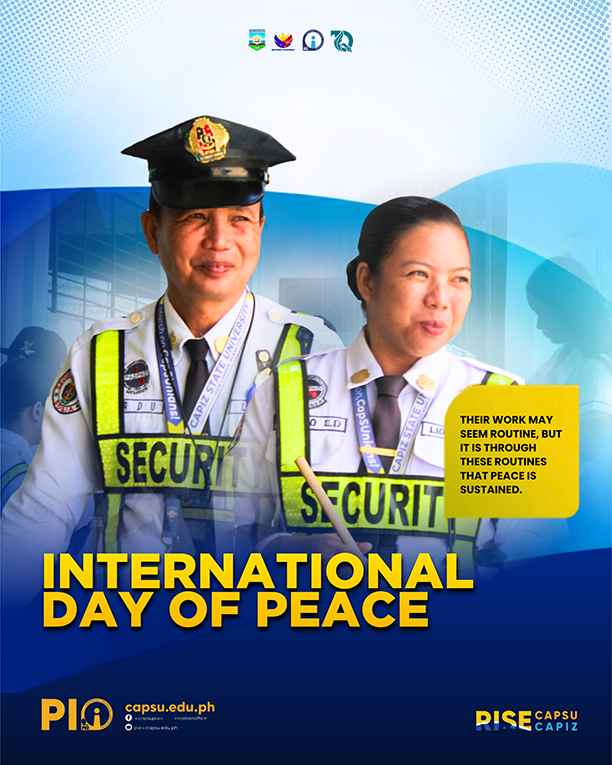
At Capiz State University, SG1 Rodulfo O. Verdadero has spent 18 years doing exactly that. He first entered the university in 2008. Since then, he has witnessed the campus change, students come and go, and countless school days unfold while he kept watch from the same post.
But after nearly two decades of standing at the gate, what does peace actually look like to someone whose job is to protect it?
For Verdadero, peace is not necessarily a silent campus or a day without problems. It can be as simple as students following the rules, people respecting one another, and difficult situations ending without becoming something bigger.
“As a guard, we should have patience and maximum tolerance gid para indi magdako ang gamo,” he said.
His words reveal something easily missed about peace: sometimes, maintaining it means absorbing the tension before it reaches everyone else.
The work requires vigilance, but it also demands restraint. It means knowing when to intervene, when to remind, and when to remain calm.
For 18 years, Verdadero has learned that keeping watch is not only about what happens at the gate, but also about what happens when people are brought together within it. While Verdadero has spent nearly two decades serving the university, another guard has spent years carrying the same responsibility from a different corner of the campus.
SG Albert D. Lorenzo has been stationed at the College of Education Building for nine years. From checking school bags to reminding students of the university’s rules, Lorenzo’s post is filled with small encounters that keep the day moving.
“Role namon nga mga security guards are to maintain peace and order,” he explained.
These may appear to be menial ordinary tasks, but in a place where thousands of students share the same space, ordinary tasks can carry extraordinary importance.
The responsibility, however, does not end with enforcing rules.
He and his fellow guards are also among the first to respond when emergencies arise, including instances when students suddenly faint and need to be carried to the clinic. In such moments, the uniform becomes more than a symbol of authority; it becomes a sign that someone is there to assist when help is needed.
“May mga students man nga ginalaygayan namon kung maga-ask sila bulig. Ginalaygayan man namon sila nga magtuon maayo para sa ila bwas damlag,” Lorenzo shared, revealing a side of security work that extends beyond enforcing rules.
For him, the role does not end at keeping order. It also involves guiding students, offering assistance, and reminding them that the rules they follow help create a safer community. In their own quiet ways, the guards become part of the everyday support system of the university.
Their work may seem routine, yet it is through these routines that peace is sustained.
As the world observes the International Day of Peace, the idea of peace often brings to mind the end of conflict. Within the Capiz State University community, peace can also be found in quieter and more ordinary acts. It is practiced through discipline, patience, and service—and the security guards of the university help sustain it every single day.
For Verdadero and Lorenzo, following the university rules is not simply a matter of enforcement but a shared responsibility. As they carry out the directives of the university, they also ask students to do their part in maintaining the order and safety of the campus.
“Let’s maintain peace. Sunod lang sa rules kay ang gina-implement sang CAPSU, para sa aton tanan,” said Lorenzo as he adjusted the metal detector in his hands.
The afternoon continues, and so do the steady movements of students, faculty, and staff through the campus gates. The metal detector beeps, IDs and bags are checked, and familiar greetings are exchanged between students and the guards standing at their posts.
For most students, these moments are part of an ordinary school day. Yet behind these routine encounters are people who quietly make that ordinary day possible.
Verdadero and Lorenzo may stand on different corners of the university, but their work speaks to the same idea: peace is built with patience, discipline, vigilance, and care.
On the International Day of Peace, their stories remind the CAPSU community that sometimes, peace does not announce itself.
Sometimes, it simply stands at the gate, wearing a uniform.
Story by: Mary Queen Tortogo and James Carlo Santiago | The Quest Publication CAPSU Main Campus
Photos by: Vanessa Argañosa | The Quest Publication CAPSU Main Campus
#CapizStateUniversity #InternationalDayOfPeace #CAPSUCommunity #RISECAPSURiseCapiz #SDG4QualityEducation #SDG11SustainableCitiesandCommunities #SDG16PeaceJusticeandStrongInstitutions