
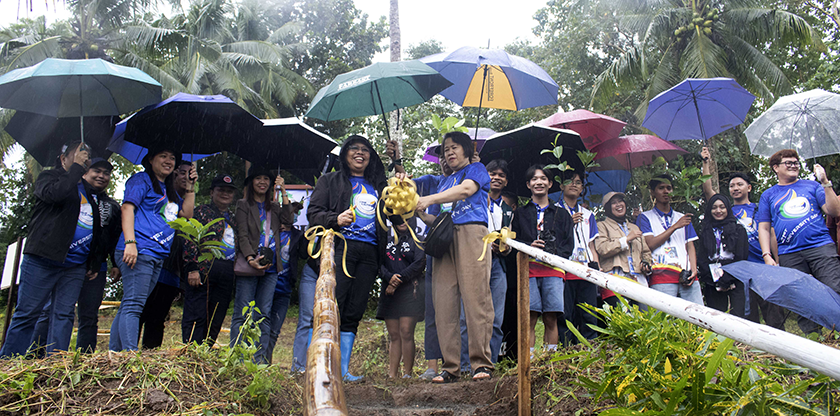
In a move to solidify its growing network of local and global alliances, Capiz State University (CAPSU) officially inaugurated the Collaboration Friendship Park on January 31, 2026. Located within the Pontevedra Campus, the park serves as a living testament to the university’s commitment to its external partners.
The project was spearheaded by Dr. Salvacion J. Legaspi, Vice President for External Affairs and Linkages. Dr. Legaspi shared that the park transcends traditional networking by offering a physical representation of mutual growth.
“As we sign agreements with our partners, we invite them to plant a tree in our friendship park. This signifies that our partnership is not only rooted in formal documents but is destined to grow and evolve. They will now have a physical ‘root’ to return to within our institution,” Dr. Legaspi stated.
Beyond its symbolic value, the park doubles as a conservation site for indigenous tree species native to the province of Capiz. This dual purpose aligns University President Dr. Efren L. Linan’s administrative vision with active environmental advocacy. “This is our contribution to protecting the environment and ensuring the survival of our local flora,” added Dr. Legaspi.
The inauguration was marked by a historic first: nine exchange students from Indonesia and Thailand under the SEA Teacher Programme participated in the initial planting. As the third batch of exchange students hosted by CAPSU, they became the first international partners to leave a tangible legacy in the park.
The park’s realization was made possible through the collaborative efforts of the Pontevedra Campus led Dr. Honey Lee E. Casa, Campus Administrator together with Prof. Malou B. Albor, (University Director for International and National Affairs), Dr. Jereline De Pablo (campus EAL chairperson), Dr. Jonan P. Burgos (campus Extension chairperson), and Dr. Harold O. Buenvenida (campus Climate Change chairperson).
With the Collaboration Friendship Park now open, CAPSU sends a clear message to its partners: their contributions are deeply valued. By moving beyond “paper agreements” to tangible environmental impact, the university ensures that its partnerships with other institutions will continue to branch out and flourish for the years to come.
I via Frederick D. Almeida, CAPSU-PIO, with information and photos from the Office of the Vice President for External Affairs and Linkages